Securing Displays in Correctional and High-Risk Facilities: Lessons from Ravenhall
What it takes to secure displays in correctional and high-risk facilities, with lessons from Gilkon's custom shrouds at Ravenhall prison.
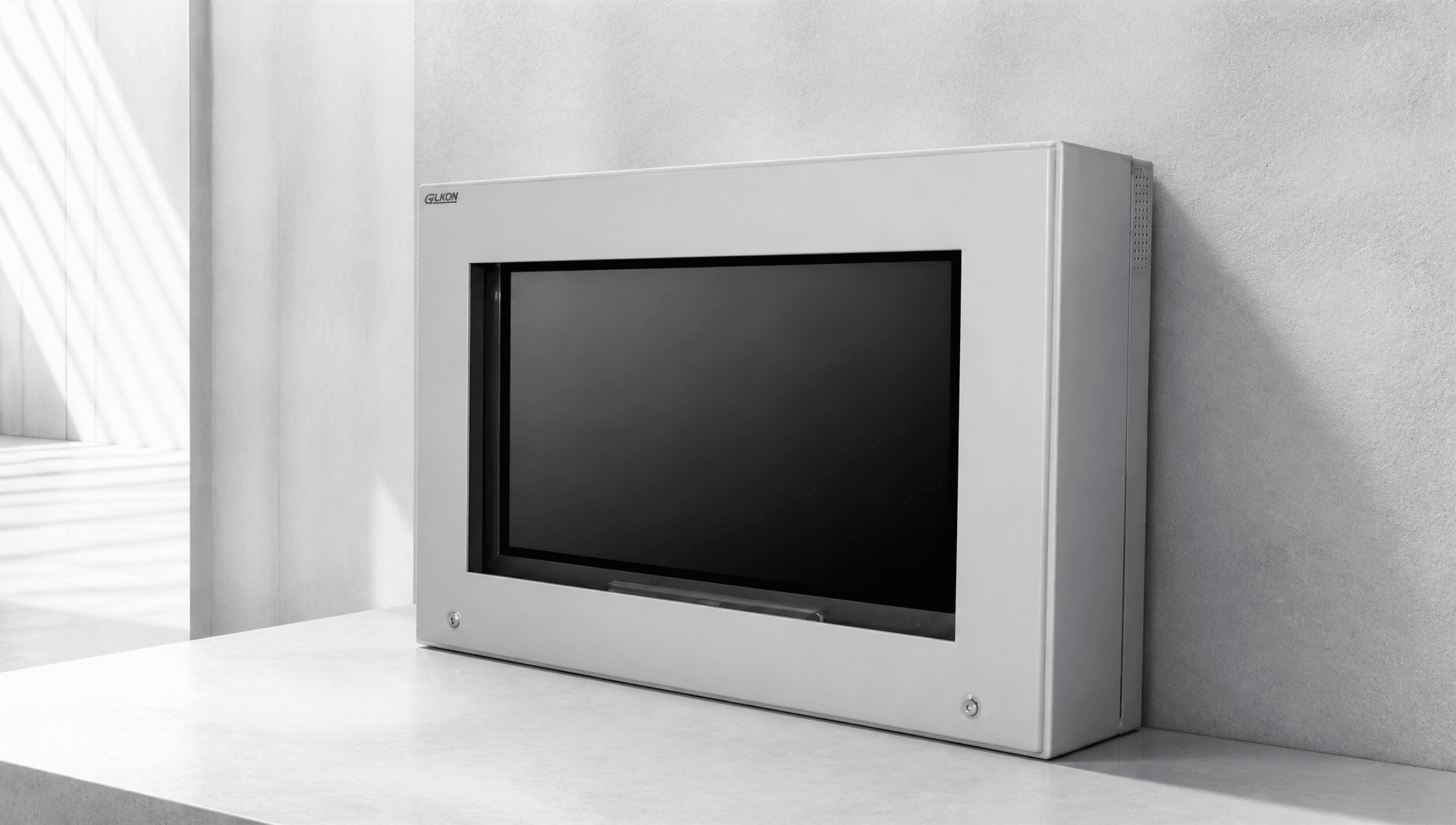
Header image: illustrative Gilkon protective display enclosure. This is not a photograph of the Ravenhall installation.
In most buildings, a display enclosure is about tidiness. In a correctional facility, it's about safety. Hardware has to resist tampering, avoid creating hazards and survive years of hard use, all while letting the display do its job. Gilkon's work at Ravenhall prison shows what that takes.
Why high-risk facilities are different
Correctional, forensic mental health and some public facilities share a set of requirements:
- Tamper resistance: no accessible fixings, gaps or edges that can be pried, removed or used to cause harm
- Durability: enclosures have to withstand deliberate damage
- Compliance: projects often specify security standards and information-security requirements
- Maintenance: authorised staff still need to service the equipment
- Consistency: hundreds of identical units, installed to a tight program
The Ravenhall project
Ravenhall is a medium-security men's prison in Melbourne's west, built as a public-private partnership and opened in 2017. Engie was contracted to install AV components in 34 of the site's 37 buildings, with project manager Firas Zain overseeing the audiovisual design and installation.
Gilkon supplied security shrouds for all IPTV displays in prison cells, as well as for the larger displays in waiting rooms and guest areas. The cell displays are 24-inch NEC models, and larger 58-inch displays are used in waiting and common areas. Every screen in the facility, including those in staff areas, is protected by a custom Gilkon shroud. Read the full story.
Five lessons
1. Design before the concrete is poured
Prison construction is planned well in advance with little margin for error. Engie had to have the AV system fully thought through before the first slab was poured. Enclosure design has to happen just as early.
2. Custom beats off-the-shelf
The Ravenhall shrouds couldn't be bought off the shelf. They were designed from scratch to meet specific pre-defined security and ISM standards. Gilkon's in-house fabrication knowledge earned it a place at the design table. As Firas Zain put it: "The Gilkon team assisted in the design of these shrouds. They gave input as to how best to achieve the initial design by the architect."
3. Review with every stakeholder
Each shroud design was reviewed by the engineering departments, the AV project manager, the builder's management team (John Holland), the architect and the client. Building that review into the program avoids late surprises.
4. QA is a schedule issue
The shrouds travelled from Sydney to Melbourne with limited time to receive and install them. "The QA had to be at the maximum level possible to ensure there would be zero units returned to supplier for any fixing, which was the case," said Firas. In a secure site, a returned unit costs far more than the unit itself.
5. Protect every screen, everywhere
Consistency simplifies maintenance and removes weak points. At Ravenhall, even staff-area screens were shrouded.
Beyond corrections
The same thinking applies to:
- Mental health and hospital units, where ligature and tamper risks matter
- Police and justice facilities
- Public spaces such as transport hubs, libraries and councils
- Schools, where projectors and displays in unsupervised rooms need protection. Gilkon projector security cages are a standard option.
- Outdoor public displays, using enclosures such as the Gilkon ODE Series
Working with Gilkon
Gilkon is now manufactured by OPIE Manufacturing Group at Emu Heights, NSW. The Ravenhall project was delivered before Gilkon joined OPIE. OPIE's in-house laser cutting, folding, welding and powder coating, under an ISO 9001 quality system, means custom security hardware can be designed, prototyped and produced in one place. OPIE also manufactures for defence and secure facilities across its brands.
Frequently asked questions
Can standard Gilkon products be used in high-risk facilities? Some can, such as projector security cages. Most high-risk projects still need custom shrouds or enclosures designed to the facility's specific requirements.
How early should enclosure design start? At design development, before construction begins. At Ravenhall, the AV design was settled before the first slab was poured.
Can you work to a client's security specification? Yes. Share it at the start, and we'll design to it and support the review process.
How are custom enclosures quality checked? Through the ISO 9001 quality system at OPIE's Emu Heights facility, with inspection checkpoints agreed for each project.
Planning a high-risk facility? Involve us at design stage. Contact the Gilkon team.
